


Early operations
No military operations were conducted by NATO during the Cold War. Following the end of the Cold War, the first operations, Anchor Guard in 1990 and Ace Guard in 1991, were prompted by the Iraqi invasion of Kuwait. Airborne Early Warning aircraft were sent to provide coverage of South Eastern Turkey, and later a quick-reaction force was deployed to the area.
Bosnia and Herzegovina intervention
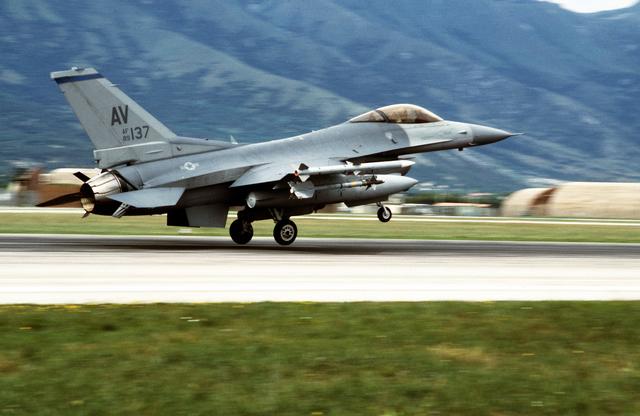
The Bosnian War began in 1992, as a result of the Breakup of Yugoslavia. The deteriorating situation led to United Nations Security Council Resolution 816 on 9 October 1992, ordering a no-fly zone over central Bosnia and Herzegovina, which NATO began enforcing on 12 April 1993 with Operation Deny Flight. From June 1993 until October 1996, Operation Sharp Guard added maritime enforcement of the arms embargo and economic sanctions against the Federal Republic of Yugoslavia. On 28 February 1994, NATO took its first wartime action by shooting down four Bosnian Serb aircraft violating the no-fly zone.
On 10 and 11 April 1994, during the Bosnian War, the United Nations Protection Force called in air strikes to protect the Goražde safe area, resulting in the bombing of a Bosnian Serb military command outpost near Goražde by two US F-16 jets acting under NATO direction. This resulted in the taking of 150 U.N. personnel hostage on 14 April. On 16 April a British Sea Harrier was shot down over Goražde by Serb forces. A two-week NATO bombing campaign, Operation Deliberate Force, began in August 1995 against the Army of the Republika Srpska, after the Srebrenica massacre.
NATO air strikes that year helped bring the Yugoslav wars to an end, resulting in the Dayton Agreement in November 1995. As part of this agreement, NATO deployed a UN-mandated peacekeeping force, under Operation Joint Endeavor, named IFOR. Almost 60,000 NATO troops were joined by forces from non-NATO nations in this peacekeeping mission.
This transitioned into the smaller SFOR, which started with 32,000 troops initially and ran from December 1996 until December 2004, when operations were then passed onto European Union Force Althea. Following the lead of its member nations, NATO began to award a service medal, the NATO Medal, for these operations.
Kosovo intervention

In an effort to stop Slobodan Milošević’s Serbian-led crackdown on KLA separatists and Albanian civilians in Kosovo, the United Nations Security Council passed Resolution 1199 on 23 September 1998 to demand a ceasefire. Negotiations under US Special Envoy Richard Holbrooke broke down on 23 March 1999, and he handed the matter to NATO, which started a 78-day bombing campaign on 24 March 1999.
Operation Allied Force targeted the military capabilities of what was then the Federal Republic of Yugoslavia. During the crisis, NATO also deployed one of its international reaction forces, the ACE Mobile Force (Land), to Albania as the Albania Force (AFOR), to deliver humanitarian aid to refugees from Kosovo.
Though the campaign was criticized for high civilian casualties, including bombing of the Chinese embassy in Belgrade, Milošević finally accepted the terms of an international peace plan on 3 June 1999, ending the Kosovo War. On 11 June, Milošević further accepted UN resolution 1244, under the mandate of which NATO then helped establish the KFOR peacekeeping force.
Nearly one million refugees had fled Kosovo, and part of KFOR’s mandate was to protect the humanitarian missions, in addition to deterring violence. In August–September 2001, the alliance also mounted Operation Essential Harvest, a mission disarming ethnic Albanian militias in the Republic of Macedonia. As of 1 December 2013, 4,882 KFOR soldiers, representing 31 countries, continue to operate in the area.
The US, the UK, and most other NATO countries opposed efforts to require the U.N. Security Council to approve NATO military strikes, such as the action against Serbia in 1999, while France and some others claimed that the alliance needed UN approval.
The US/UK side claimed that this would undermine the authority of the alliance, and they noted that Russia and China would have exercised their Security Council vetoes to block the strike on Yugoslavia, and could do the same in future conflicts where NATO intervention was required, thus nullifying the entire potency and purpose of the organization. Recognizing the post-Cold War military environment, NATO adopted the Alliance Strategic Concept during its Washington summit in April 1999 that emphasized conflict prevention and crisis management.
Afghanistan War

The September 11th attacks in the United States caused NATO to invoke its collective defence article for the first time.
The September 11th attacks in the United States caused NATO to invoke Article 5 of the NATO Charter for the first time in the organization’s history. The Article says that an attack on any member shall be considered to be an attack on all. The invocation was confirmed on 4 October 2001 when NATO determined that the attacks were indeed eligible under the terms of the North Atlantic Treaty.
The eight official actions taken by NATO in response to the attacks included Operation Eagle Assist and Operation Active Endeavour, a naval operation in the Mediterranean Sea which is designed to prevent the movement of terrorists or weapons of mass destruction, as well as enhancing the security of shipping in general which began on 4 October 2001.
The alliance showed unity: on 16 April 2003, NATO agreed to take command of the International Security Assistance Force (ISAF), which includes troops from 42 countries. The decision came at the request of Germany and the Netherlands, the two nations leading ISAF at the time of the agreement, and all nineteen NATO ambassadors approved it unanimously. The handover of control to NATO took place on 11 August, and marked the first time in NATO’s history that it took charge of a mission outside the north Atlantic area.

ISAF was initially charged with securing Kabul and surrounding areas from the Taliban, al Qaeda and factional warlords, so as to allow for the establishment of the Afghan Transitional Administration headed by Hamid Karzai. In October 2003, the UN Security Council authorized the expansion of the ISAF mission throughout Afghanistan, and ISAF subsequently expanded the mission in four main stages over the whole of the country.
On 31 July 2006, the ISAF additionally took over military operations in the south of Afghanistan from a US-led anti-terrorism coalition. Due to the intensity of the fighting in the south, in 2011 France allowed a squadron of Mirage 2000 fighter/attack aircraft to be moved into the area, to Kandahar, in order to reinforce the alliance’s efforts. During its 2012 Chicago Summit, NATO endorsed a plan to end the Afghanistan war and to remove the NATO-led ISAF Forces by the end of December 2014. ISAF was disestablished in December 2014 and replaced by the follow-on training Resolute Support Mission.
Iraq training mission
In August 2004, during the Iraq War, NATO formed the NATO Training Mission – Iraq, a training mission to assist the Iraqi security forces in conjunction with the US led MNF-I. The NATO Training Mission-Iraq (NTM-I) was established at the request of the Iraqi Interim Government under the provisions of United Nations Security Council Resolution 1546. The aim of NTM-I was to assist in the development of Iraqi security forces training structures and institutions so that Iraq can build an effective and sustainable capability that addresses the needs of the nation.
NTM-I was not a combat mission but is a distinct mission, under the political control of NATO’s North Atlantic Council. Its operational emphasis was on training and mentoring. The activities of the mission were coordinated with Iraqi authorities and the US-led Deputy Commanding General Advising and Training, who was also dual-hatted as the Commander of NTM-I. The mission officially concluded on 17 December 2011.
Gulf of Aden anti-piracy

Beginning on 17 August 2009, NATO deployed warships in an operation to protect maritime traffic in the Gulf of Aden and the Indian Ocean from Somali pirates, and help strengthen the navies and coast guards of regional states. The operation was approved by the North Atlantic Council and involves warships primarily from the United States though vessels from many other nations are also included.
Operation Ocean Shield focuses on protecting the ships of Operation Allied Provider which are distributing aid as part of the World Food Programme mission in Somalia. Russia, China and South Korea have sent warships to participate in the activities as well.
Libya intervention
During the Libyan Civil War, violence between protestors and the Libyan government under Colonel Muammar Gaddafi escalated, and on 17 March 2011 led to the passage of United Nations Security Council Resolution 1973, which called for a ceasefire, and authorized military action to protect civilians. A coalition that included several NATO members began enforcing a no-fly zone over Libya shortly afterwards.
On 20 March 2011, NATO states agreed on enforcing an arms embargo against Libya with Operation Unified Protector using ships from NATO Standing Maritime Group 1 and Standing Mine Countermeasures Group 1, and additional ships and submarines from NATO members. They would “monitor, report and, if needed, interdict vessels suspected of carrying illegal arms or mercenaries”.

On 24 March, NATO agreed to take control of the no-fly zone from the initial coalition, while command of targeting ground units remained with the coalition’s forces. NATO began officially enforcing the UN resolution on 27 March 2011 with assistance from Qatar and the United Arab Emirates.
By June, reports of divisions within the alliance surfaced as only eight of the 28 member nations were participating in combat operations, resulting in a confrontation between US Defense Secretary Robert Gates and countries such as Poland, Spain, the Netherlands, Turkey, and Germany to contribute more, the latter believing the organization has overstepped its mandate in the conflict.
In his final policy speech in Brussels on 10 June, Gates further criticized allied countries in suggesting their actions could cause the demise of NATO. The German foreign ministry pointed to “a considerable [German] contribution to NATO and NATO-led operations” and to the fact that this engagement was highly valued by President Obama.
While the mission was extended into September, Norway that day announced it would begin scaling down contributions and complete withdrawal by 1 August. Earlier that week it was reported Danish air fighters were running out of bombs. The following week, the head of the Royal Navy said the country’s operations in the conflict were not sustainable.[105] By the end of the mission in October 2011, after the death of Colonel Gaddafi, NATO planes had flown about 9,500 strike sorties against pro-Gaddafi targets. Following a coup d’état attempt in October 2013, Libyan Prime Minister Ali Zeidan requested technical advice and trainers from NATO to assist with ongoing security issues.